What is The Tao?
Taoism is an ancient philosophy, which embodies the concepts of universal balance. The word ‘Tao’ means the way, or path, and encapsulates the method of maintaining harmony between this world and the greater universe.
To the ancients the entire universe followed one course, which manifested through the cycle of the seasons, changes from day to night and contained in all aspects of life from birth, through growth, to decay and death. Hence, the only way man could attain the ‘Tao’ was by complete adjustment and harmonisation with the course of the universe.
“In the past, people practiced the Tao, the Way of Life. They understood the principle of balance, of yin and yang, as presented by the transformation of the energies of the universe. Thus they formulated practices such as Dao-In, an exercise combining stretching, massaging and breathing to promote energy flow,and meditation to help maintain and harmonise themselves with the universe. They ate a balanced diet at regular times, arose and retired at regular hours, avoided overstressing their bodies and minds and refrained from overindulgence of all kinds. They maintained well-being of body and mind: thus, it is not surprising that they lived over one hundred years.”
(Yellow Emperor’s Classic of Chinese Medicine)
What is Qi?
Qi is Life-force energy. Qi is everywhere and in everything. It is the very force that keeps us alive, gives us initiative and drives and inspires us. It maintains our physical form and affects our mind and spirit.
Qi flows through the channels (meridians) in the body. The meridians run close to the surface of the skin as well as going deep into the body to connect with the organs. There are twelve main channels and each of these is associated with and named after a specific organ.
According to TCM (Traditional Chinese Medicine) all the organs have an energetic nature and function as well as a physical function. This belief and practice distinguishes it from western medicine which acknowledges only the physical structure of the body and the organs in particular.
For example, in TCM, the Kidney organ and energy affects the function of the reproductive system, lower back, knees, Central Nervous System and bones. In conventional western medicine it is an organ in the lower abdomen which has a specific physical function related to purifying the body of wastes etc.
In TCM you have a system of medicine that sees all things as connected to each other and part of the whole organism. The organs have a physical structure and function and an energetic structure, function and dynamic interaction with every other organ. This interplay is what determines a person’s health and state of balance.
In Oriental Medicine, health and balance in a person depends on three main things:
- The smooth flow of Qi and Blood
- Good quality Qi and Blood
- Correct functioning of the organs
We produce Qi through the intake of air, food and water. Qi circulates around the body through the meridians enabling and nurturing the correct function of the organs and all bodily functions. When Qi is flowing smoothly, without disturbance, health is maintained. When the flow of Qi is disrupted or blocked, imbalance can occur resulting in stress on the system which can then lead to disease. Imbalance may occur in one or more meridians or organs, which in turn creates energy disturbances in other organs and meridians. Wu Tao is a good remedy for disharmonies of Qi since it helps to re-establish a balanced flow of Qi throughout the whole body.
The Five Elements of Nature
In TCM there are 5 elements. These elements are Metal, Water, Wood, Fire and Earth. Each of these have relationships with the other elements, and a balanced, harmonious relationship between them is what is sought to maintain good health within all aspects of our being. Through this intricate system, we have an opportunity to work with the forces of nature as they move in us, rather than fight against them.
The Supporting cycle, also known as the creating or nurturing cycle, is where each element nurtures the growth of the next element following it. Just as a mother nurtures and supports her child, in this relationship, each element has a supportive role to play in the cycle.
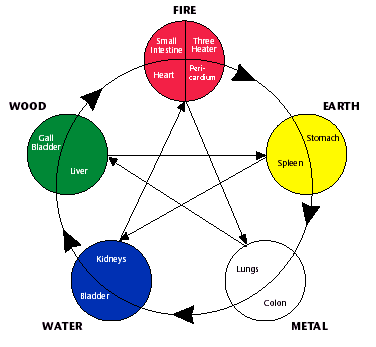
(image from sungatehealth.com)
A good example of how each element supports the other is in a description of the life cycle.
Water
Water is the season of winter, where the seed lays dormant in the earth. With the winter rains, the seed is germinated and begins to grow.
Supports Wood
Wood is the season of spring. The new green shoots, nurtured into life by the water, begin a period of rapid, energetic growth.
Wood supports Fire
Fire is the season of summer. Our plant now begins to flower and bear fruit.
Fire supports Earth
Earth brings the fullness of late summer, where the fruit is ripe and falling off the trees, signals harvest time.
Earth supports Metal
Metal is the season of autumn. The trees are empty of fruit and flowers, and slowly begin to drop their leaves.
Another Cycle in TCM is the Control Cycle, where each element has a restraining or controlling effect on another. In this cycle, Water controls Fire, Fire controls Metal, Metal controls Wood, Wood controls Earth, and Earth controls Water. In Wu Tao we are primarily working with the supportive cycle as each dance engenders and nourishes the energy of the following dance.