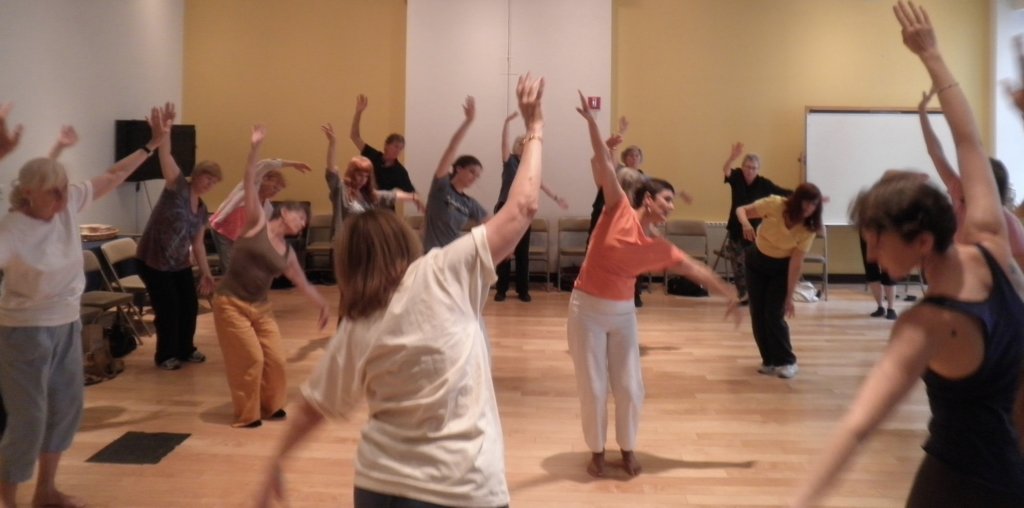
The purpose of doing an introductory workshop is to provide education and motivation to newcomers that convert to people signing up for your course, class series or workshop. This is the outline for a workshop that can be delivered in 1.5 -2 hours. I’ve broken it down into sections as below. You will also find exercises interspersed between the sections to assist you in creating your own unique workshop content. It’s important that you make the workshop your own. In the resource section you will find a webinar/tutorial that explains the steps in more detail with students contributing to the lesson.
- Section 1: Introduction
- Section 2: What is stress?
- Section 3: Making the case for stress
- Section 4: So Why Dance?
- Section 5: The Traditional Chinese Medicine approach to Health is Holistic
- Section 6: What is Wu Tao and how does it work
- Section 7: Questions
- Section 8: Preparing to Dance Meditation
- Section 9: Introductory Class
- Section 10: Checking in and Questions
- Section 11: Workshop Completion
[divider style=”2″]
Talk Section 1: Introduction
Thank you for coming. I know you’ve come to find out more and experience Wu Tao Dance, but before we get started on that, I’d like to talk to you about why Wu Tao exists in the first place. Wu Tao is a therapeutic dance process that reduces stress and restores physical and emotional balance.
Talk Section 2: What is stress?
So let’s talk about stress.
But before I go on, can we get a show of hands and rate your stress on a scale of 1 -10. 10 being maximum stress. Both hands up for maximum, 1 hand up for moderate stress, no hands if you don’t have any.
Great thanks.
Can I also just ask you to put your hand up if its a short term stress, going to be over by tomorrow?
Long term you’ve had it longer than a week?
Ok great thanks for sharing.
[divider style=”2″]
Exercise 1
What do you want to say about stress….. Give some facts, do some research and find out what resonates with you about stress that you feel comfortable talking about and sharing with your group.
[divider style=”2″]
Talk Section 3: Making the case for stress
Now according to the research, short lived acute stress is not the problem, however long term stress is the biggest contributor to premature aging, and it’s been shown in many different studies to increase our risk of developing diseases such as diabetes, heart disease, dementia, depression, obesity, and inflammatory conditions such as arthritis and asthma.
So how and why does this happen?
Latest research shows that chronic stress shortens telomeres. Telomeres are the caps on the ends of our chromosomes. When telomeres shorten to a certain length they stop dividing. No new cells being produced, results in aging in every variety of cell in the body. At the same time, the energy centre of the cell the mitochondria stops working properly. They start to leak free radicals and the cells become filled with oxidative stress. This puts a lot of pressure on the body to get rid of these unstable molecules.
There are a ton of new studies being done right now that are looking at how stress causes telomeres to shorten and what can be done about it. And importantly there are studies that have found that telomeres can lengthen with lifestyle and psychological interventions.
This is such important information because it gives us a great opportunity to take a really close look at what we can do to reduce the impact of stress and indeed live a long happy life in a vibrant healthy body.
So let me tell you what the research is showing around lengthening telomeres.
Firstly, mind is as important as the body. Stress is in the mind AND it’s in our cells.
What this means is that how we react to stress mentally, is as important as what happens in our bodies physically.
Studies have shown that worrying also known as ruminating, shortens telomeres. Crazy right but true!
Researcher Elissa Epel put it like this: R & R that is seeing red and ruminating arouses a stress response and keeps it high resulting in chronic stress
People who feel threatened under pressure, and feel overwhelmed and unable to cope have shorter telomeres than people who felt they could cope and were able to maintain presence.
So research shows that movement and exercise that can protect us from stress.
Another study has found a direct link between certain positive behaviours and stress reduction.
I’ll share the whole list with you later but 2 of my favourites on the list are gratitude and mindfulness..
[divider style=”2″]
Exercise 2
Watch this video to find out more about chronic stress and do some research of your own.
[divider style=”2″]
Talk Section 3: Your Story
Your story is vitally important. It helps the audience connect and empathise with you, and it sets the stage for them to become interested in what you are offering them.
[divider style=”2″]
Exercise 3
Here’s a question to ask yourself to help you work it out…
- What part of your story does your soul want to share?
Give yourself an hour to meditate on this question and write down your answers. You will gain plenty of material to use in your personal story that is authentic, powerful and real.
[divider style=”2″]
Your Wu Tao story should also include:
- Where you were at before you started it
- What drew you to it
- How it helped you
- Where you are now
- Your key message of why you teach and do it.
Write out your story in it’s completion.
[divider style=”2″]
Talk Section 4: So Why Dance?
Research is showing the great benefits of therapeutic dance for people in many different areas. It’s helping people with chronic illnesses that include alzheimer’s disease, parkinson’s disease, asthma, diabetes, heart disease and even cancer.
Dance like other forms of exercise increases endorphins which creates a state of well-being. The total body movement of dance enhance the functions of other body systems such as the circulatory, respiratory, skeletal and muscular systems. Dance has been shown to reduce stress, anxiety and depression, decrease chronic pain and increase social connections and communication skills.
One neuroscientist has coined dance the brain’s “pleasure double play” because music stimulates the brain’s reward centres while dance activates it’s sensory and motor circuits. Dance stimulates left and right brain function. Logical and creative thinking are both in action as you work out the steps, find balance and express yourself through the movements.
For people who love music and movement, dance is the perfect form of exercise.
[divider style=”2″]
Exercise 4
Read through the above section and adapt to suit your own talk. Do some research of your own, so you can build your talk on what you know and believe in. Here’s some dance research articles to get you started.

[divider style=”2″]
Talk Section 5: The Traditional Chinese Medicine approach to Health is Holistic
A little introduction to Chinese Medicine…
Chinese Medicine is an ancient proven health system that is used in Acupuncture, Tai Chi, Chi gong, Shiatsu and Wu Tao.
It’s philosophy is based on the principle of wholeness. Everything is connected in the universe. Human beings are a microcosm of the macrocosm. We are made up of the same substance and are guided by the same principles as all of nature. Therefore their philosophy recommends aligning with the natural cycles and following the example of nature.
Qi is life force energy. This energy imbues every part of life and it’s always moving. When Qi isn’t moving, stagnation and blockage occurs both in the natural world and in our bodies. A good example is of a stagnant pond of water. Fish die, poisonous algae grow because the energy is not moving well. This happens in our bodies too, and when the energy does not flow properly through our system we end up with pain, imbalance and disease.
[divider style=”2″]
Exercise 5
Reflect on the above description about TCM. Is there anything you’d like to change or add? Does it resonate with you? Revise and adapt the section to align with your understanding of TCM and what you feel comfortable talking about.
[divider style=”2″]
Talk Section 6: What is Wu Tao and how does it work
Wu Tao is a series of dances done to beautiful musicAnd what it does is balances the energy (called Qi) in your body.
When your Qi is flowing properly it:
- Increases your energy
- Eases your stress levels
- Restores balance
- Energises your cells and organs
- And brings your mind back to a natural state of clarity and peaceful, easy joy
In the Chinese Medicine system the energy flows through a network of channels, called meridians. And these meridians connect with your internal organs.
The 5 core dances of Wu Tao relate to the 5 elements and stimulate energy flow through their corresponding organs and meridian system.
So by doing Wu Tao you are stimulating and toning all the organs of your body, which helps to prevent disease and restore health to organs already out of balance.
And the beauty of Wu Tao is that the dances can be learned easily and enjoyed by anyone.
And it only takes about half an hour to do a whole dance meditation.
[divider style=”2″]
Exercise 6
Reflect on the above description about Wu Tao. Is there anything you’d like to change or add? Does it resonate with you? Revise and adapt the section to align with your understanding of Wu Tao and what you feel comfortable talking about.
[divider style=”2″]
Talk Section 7: Questions
Does anyone have any questions at this stage?
Talk Section 8: Preparing to Dance Meditation
So before we get up and learn some of the dance movements, I’d like you to close your eyes for a moment.
Close your eyes
Deep breaths in and out.
Relax your body
Relax your mind
Imagine changing gear and bringing your mind into neutral.
Not going forwards or backwards in time
Just here for the moment.
Now just gently scan through your body.
Relaxing more with each breath
Noticing how your body is feeling.
Are there any areas of pain?
Any places where you feel tight or blocked?
Make no judgement,
Just notice what is happening in your body
Do you feel any fatigue or tiredness?
Now bring your breath into your heart area.
Nice deep breaths
Relaxing on the exhale.
Softening around your heart.
Just acknowledge that you are safe in this space.
It’s safe to relax and be yourself here.
Become aware of how you are feeling.
What has your week been like?
Are you carrying around any stress or anxiety?
Are there any conflicts or strong emotions that are present for you now?
Now take your breath into your mind
And as you breath out let all your thoughts drift away
Step back from your thoughts.
Take a moment and remind yourself
I am not my thoughts
Now ask yourself,
With everything that you’re aware of about yourself in this moment,
Where do I need healing?
Nice deep breaths
Every breath becoming more relaxed
And open to receiving exactly what you need from this session.
When you’re ready open your eyes and let’s get into the dance!
[divider style=”2″]
Exercise 7
Become familiar with the above meditation. Rewrite in your own words. Make sure you can deliver it without reading it from a page.
[divider style=”2″]
Talk Section 9: Introductory Class
Warm ups (walking, shake and breath whatever you like to do)
Makko Hos (of course!)
Warm up Wisdom dance (to Tao music if you know it).
Just put the music on and have them follow you.
Then teach your favourite 3 dances!
(Mine are Air, Fire and Earth for an Intro workshop).
Have a short break 5 – 10 minutes after the second dance.
Deep Peace or 5 Element meditation to finish the session
[divider style=”2″]
Exercise 7
Reflect on the content of the class. Does this feel right for you? Change and adapt if needed. Get clear about what feels appropriate for your class demographic, age, ability and environment. Rewrite your class outline.
[divider style=”2″]
Talk Section 10: Checking in and Questions
So how are you feeling now? Any changes in your body or state of mind?
Have you found this helpful?
How do you think you’d feel in your life if you were doing this once or twice a week? Would you feel healthier? Less stressed?
Share and discuss in the group if possible
Give positive reinforcement to their experience.
Any questions?
[divider style=”2″]
Exercise 8
Are there any other questions you want to add?
[divider style=”2″]
Talk Section 11: Workshop Completion
Before we wind up I’d like to let you know how you can continue to experience the peace of mind and balanced energy that Wu Tao brings.
Offering
Your classes and workshops
If you sign up for my class series now, I’d love to offer you a special gift of a free (create your free gift) to help you with your practice. Put your name down here, and at your first class you’ll receive a link to your free gift.
I am only offering this incentive tonight, because I know when you walk out that door, it’ll be easy to forget about how good you felt here, when life, family, and work begins pulling at you from a hundred directions again. Women forget about themselves and then kick themselves later for not taking action when they wanted to. I’ve done it myself many times. I don’t want that to happen to you”.
I can’t wait to see you at the class and I’d love to share more of this beautiful work with you. It’s been a pleasure getting to know you all. You’re an amazing group of women/men/people doing a great job of balancing your life. If you want to have more peace and and less stress as you journey on, I’ld love to help you find that..
Complete the class registration form and then if you have any questions I’ll be at the back of the room. Thank you all so much for coming today and I hope you’ve enjoyed yourself!
[divider style=”2″]
Exercise 9
Create a free incentive gift for the people that sign up today. This could be an ebook or meditation download that you send them after the first class. It could be a good discount on the 6 week course. Doing this will have a number of benefits for you.
- You establish yourself as an authority by giving them something you have developed especially for them.
- They have an incentive to sign up TODAY while they are motivated
[divider style=”2″]
Resources
Watch this tutorial from a webinar held in 2017.
Read this page for more information on how to successfully close your workshop